
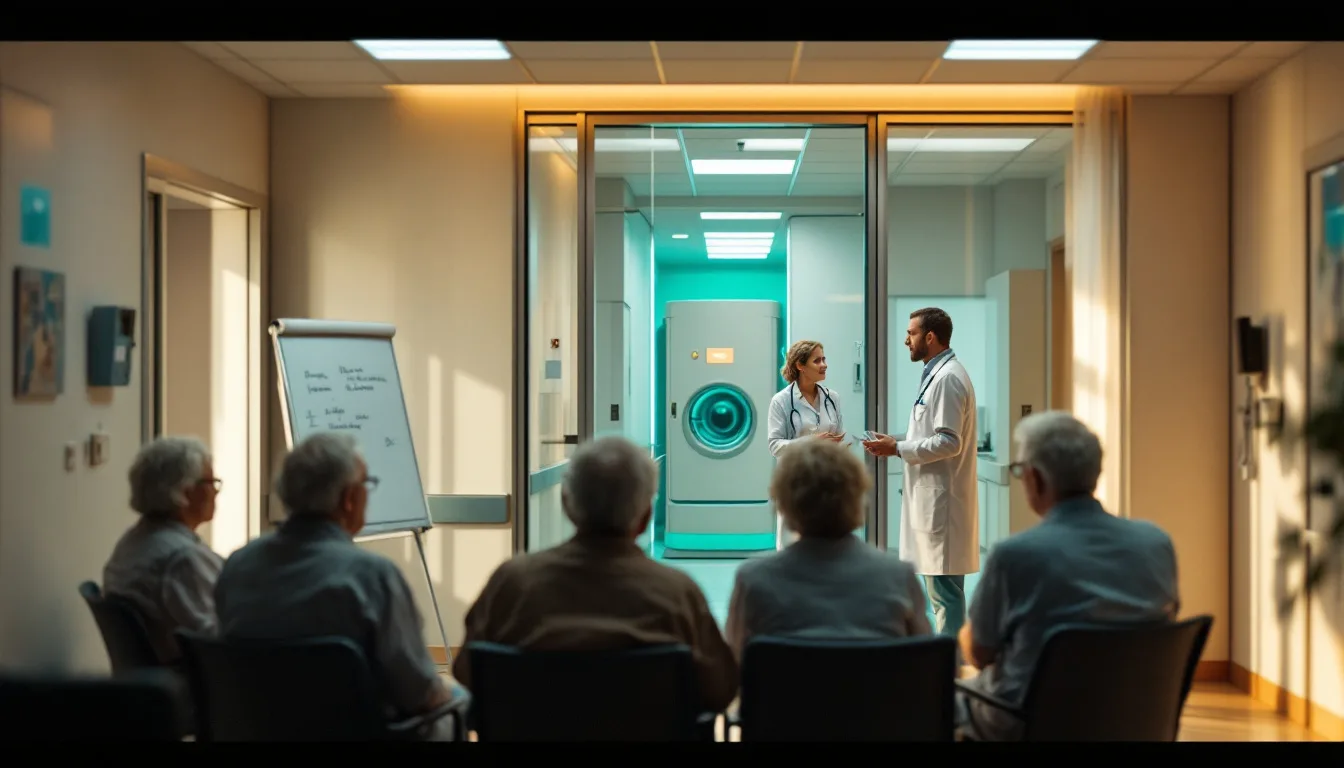
The people who fill hyperbaric oxygen chambers are rarely the patients in the brochure. They are, more often than not, older adults carrying several diagnoses at once — diabetes alongside peripheral vascular disease, a cancer history alongside radiation-damaged tissue, a non-healing wound alongside the kidney disease that helped cause it. Their medication lists run long. And their treatment course will put them in a chamber for an hour or more a day, five days a week, for a month and a half.
That waiting room is what prompted a team at the Department of Diving and Hyperbaric Medicine at Royal Hobart Hospital in Tasmania to try something out of the ordinary. If these patients are going to spend six weeks inside a tertiary hospital anyway, the reasoning went, could the hospital also teach them something about how they live the rest of the time?
Their answer, published on 30 September in the journal Diving and Hyperbaric Medicine, is a qualified yes — and it arrives with far more caveats than headlines.
Six weeks, twelve patients, and a very small department
The experiment was bluntly labelled a feasibility study, and it reads like one. Over six weeks at the Hobart department, patients receiving hyperbaric oxygen treatment (HBOT) were invited to a weekly group education session built on the six pillars of lifestyle medicine, delivered with motivational-interviewing techniques and reinforced by newsletters. Twelve patients were recruited through rolling recruitment; eleven completed the post-programme questionnaires. Seventeen staff members filled out their own survey.
The lifestyle-medicine framework the programme drew on is not exotic. It is the same six-domain package taught in preventive-medicine clinics across Australia and the United States — plant-predominant nutrition, physical activity, stress management, restorative sleep, avoidance of risky substances such as alcohol and nicotine, and positive social connection. A 2023 review in Cureus summarised the same six pillars in the context of brain health, noting associations between each and cognitive decline.
What the Hobart team measured was not whether any of that improved a wound or reversed a disease. It measured whether the programme could be delivered at all, and whether the people in the room wanted it.
What came back
By the study’s own account, the reception was warm. Every one of the eleven respondents said they would recommend the programme; ten reported finding it beneficial. The qualitative material, drawn from short answers and focus groups, pointed to two things patients valued most: the social connection that came from sitting in a group, and a renewed sense of self-agency — the idea that there was something they could do for themselves outside the chamber.
The frictions are more interesting than the praise, because they are the parts that would decide whether such a programme could survive contact with a real department. Patients flagged accessibility problems. Some struggled with how the programme was framed, unsure how a nutrition and sleep class related to the therapy they had come for. And the researchers noted a delicate question of therapeutic alliance: the lifestyle message has to sit alongside the hyperbaric treatment rather than appear to compete with it. Staff were broadly positive, but conditional — they judged the programme workable only if logistical and structural adjustments were made first.
A single-centre, unblinded, twelve-patient study proves very little
It is worth being exact about the strength of this evidence. This was an open-label feasibility study with no control group, no randomisation, no blinding and a sample size of twelve, conducted in one small Australian department. It cannot show that pairing lifestyle education with HBOT improves any clinical outcome, because it was never designed to. The authors say so themselves, calling for larger, multi-site trials to test scalability, inclusivity and long-term feasibility. Treat the result as a signal about acceptability, not a result about health.
Why a hyperbaric unit would go looking for this
The strategic logic is easier to see than the data. Hyperbaric departments have a structural quirk: they see the same chronically ill patients repeatedly, for weeks, in a setting that already normalises medical self-management. That is an unusually good environment in which to deliver education that most clinics can only dream of having the contact hours for. It is also a way for departments facing flat referrals to justify their footprint.
There is a reason multimorbidity and polypharmacy keep surfacing in hyperbaric caseloads. The FDA-cleared indications themselves skew toward older, sicker patients — non-healing diabetic lower-extremity wounds, late radiation tissue injury, compromised skin grafts and flaps, chronic refractory osteomyelitis. Most of these patients are, by definition, managing more than one chronic condition. Medicare’s coverage rules for HBOT in diabetic wounds, set out in National Coverage Determination 20.29, only add to the concentration of complex patients in these units.
The trap is the slide from “these patients have other problems” to “the chamber treats other problems.” It does not. HBOT devices are Class II devices cleared through the 510(k) pathway under Product Code CBF, and their cleared indications are a specific, short list — decompression sickness, carbon monoxide poisoning, certain non-healing diabetic wounds, late radiation tissue injury, gas gangrene, severe anaemia, select grafts and flaps, crush injury, thermal burns, idiopathic sudden sensorineural hearing loss and intracranial abscess. Multimorbidity is not on it. Neither is longevity, cognitive enhancement or general chronic-disease reversal, no matter how often those terms appear in the marketing of clinics that have added hyperbaric chambers to their service menus.
The safety caveat that attaches to every chamber programme
The FDA’s August 2025 letter to health care providers remains the anchor here. The agency said it was aware of reports of serious injuries and deaths with HBOT devices, including fires, and that the root cause of the fire events was not yet known. Its recommendations are procedural but non-negotiable for any department layering new programming onto its chamber schedule: follow the manufacturer’s instructions, maintain fire prevention measures, train and keep staff current, monitor the patient for the full duration of the treatment, keep up cleaning and maintenance intervals, and control what — and who — goes inside the chamber, including electrical and static-producing items.
Adding a nutrition class to a hyperbaric course does not extend a device’s clearance, does not create evidence that HBOT reverses chronic disease, and does not reduce the fire and monitoring obligations the FDA spelled out. What the Hobart study suggests is narrower and more defensible: that hyperbaric departments may be a practical place to deliver chronic-disease education patients would otherwise never receive, and that the obstacles are logistical rather than conceptual.
Whether that translates into better outcomes is exactly the question a twelve-patient feasibility study cannot answer. The authors have already said what comes next: bigger, multi-site, and let the hard endpoints decide.
Sources
- Elliott E, Manger S, Mercer J, Stevens J. A feasibility study of combined hyperbaric oxygen treatment and a lifestyle medicine program for multimorbid conditions. Diving and Hyperbaric Medicine. 2026;56(3):245-256. doi:10.28920/dhm56.3.245-256
- Jaqua E, Biddy E, Moore C, Browne G. The Impact of the Six Pillars of Lifestyle Medicine on Brain Health. Cureus. 2023;15(2):e34605. doi:10.7759/cureus.34605
- FDA — Follow Instructions for Safe Use of Hyperbaric Oxygen Therapy Devices: Letter to Health Care Providers (August 25, 2025)
- CMS — National Coverage Determination 20.29: Hyperbaric Oxygen Therapy