
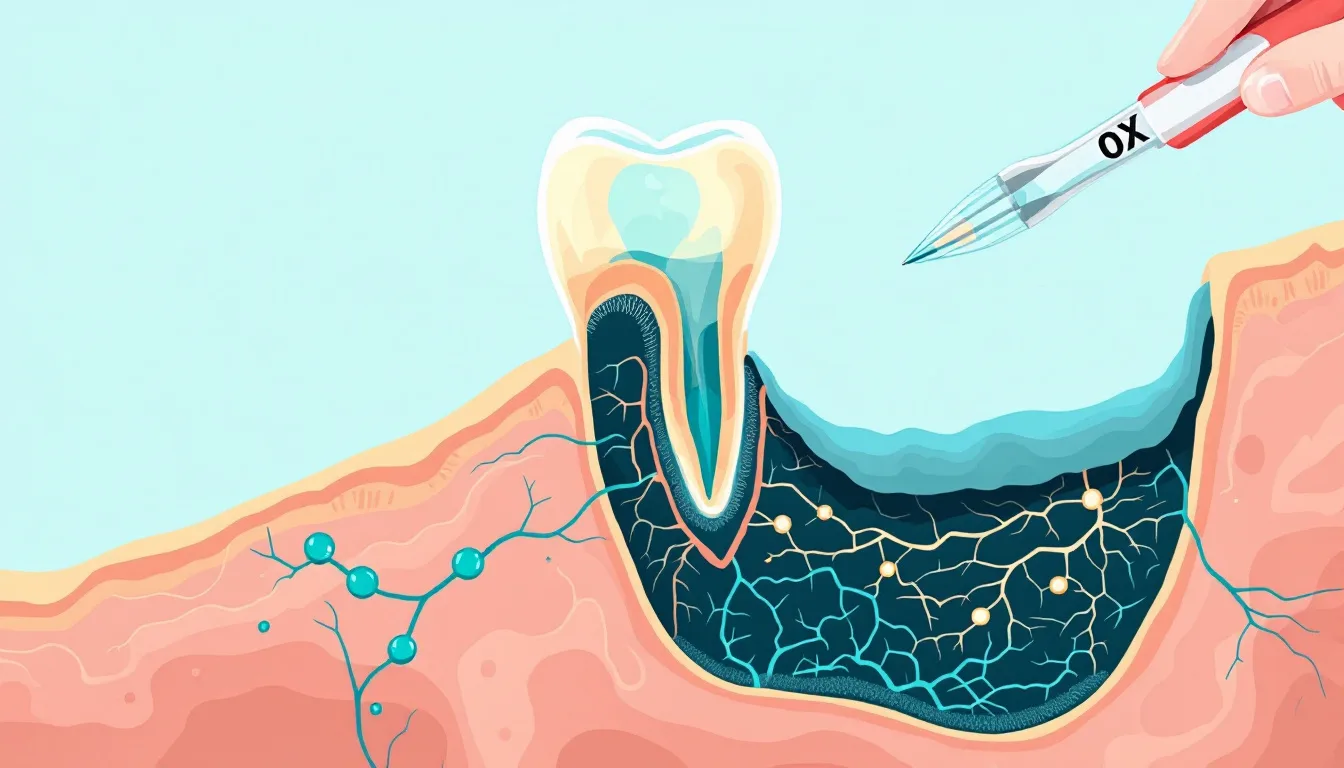
The sequence is common enough that oral surgeons recognise it on sight. A patient on a bone-modifying drug — zoledronic acid or denosumab, often for myeloma, breast or prostate cancer, sometimes only for osteoporosis — has a tooth extracted. Weeks pass. The socket does not close. Bone sits exposed in the mouth, pale and unresolving, and the usual answers (rinse, antibiotic, debride, wait) work slowly or not at all.
That condition is medication-related osteonecrosis of the jaw, or MRONJ, and it is one of the few pockets of medicine where a hyperbaric chamber is still routinely wheeled in on hope rather than on a clearance. A new retrospective series from Portugal has now added its numbers to a literature that remains, by its own authors’ admission, thin.
A necrosis that has nothing to do with radiation
The clinical definition used by oncology guidelines is precise. A patient qualifies if they have current or previous treatment with a bone-modifying agent or an angiogenic inhibitor; if they have exposed bone — or bone that can be probed through a fistula — in the jaw region that has persisted longer than eight weeks; and if they have no history of radiation to the jaws and no metastatic disease there. That third clause matters, because it separates MRONJ from osteoradionecrosis, a different disease with a different evidence base.
The frequency follows the drug and the dose. Cochrane’s background section puts it bluntly: the complication occurs rarely after oral bisphosphonates or denosumab given for osteoporosis, and commonly after intravenous bisphosphonates given for cancer.
Why would oxygen help bone that is simply dying? The dominant pathophysiological model is a triad — hypovascular, hypocellular, hypoxic tissue — in which the mineral scaffold is starved of blood supply and of the cells that would remodel it. Raising tissue oxygen tension is, on paper, addressing the third leg of that triad directly. A 2023 minireview in JBMR Plus by researchers at UCLA, Indiana University and Stony Brook, however, is careful to puncture the confidence that such reasoning invites: despite two decades of reports, the authors write, MRONJ’s etiology, pathophysiology and progression “remain largely unknown,” and current treatment strategies are “mostly empirical.”
Eighteen patients in Matosinhos
Into that gap comes the new paper, published in Undersea and Hyperbaric Medicine by a team at Hospital Pedro Hispano in Matosinhos, Portugal. Eighteen patients treated for MRONJ in a single hyperbaric medicine unit were analysed retrospectively, most of them women, with a mean age of 60.6. The primary outcome was clinical response, and 61.1 percent of patients showed one.
The reported improvements are more granular than that headline figure. MRONJ stage severity fell significantly, as did pain intensity, the number of oral lesions, the area of exposed bone, and orofacial inflammatory signs. But five patients relapsed after treatment, with a median time to relapse of two months, and univariate analysis found no baseline variable that predicted either improvement or relapse. The authors’ own conclusion is appropriately modest: the findings “support the hypothesis” that hyperbaric oxygen is beneficial as an adjunct, and “larger studies are necessary.”
This is a single-centre case series with no control arm, which caps what it can prove. It can show that a group of patients improved on several measured dimensions. It cannot show that the chamber is why. MRONJ can stabilise or partially heal with antiseptic rinses, antibiotics, surgical debridement and interruption of the offending drug — and some lesions do quieten down on their own.
What the higher tiers of evidence say
The randomised evidence is both sparse and unflattering. The 2022 Cochrane review of interventions for MRONJ, led from Ulm University, found 13 randomised trials with 1,668 participants — and exactly one that tested hyperbaric oxygen on top of standard care. That trial, with 46 participants, produced a risk ratio for healing of 1.56 with a confidence interval of 0.77 to 3.18: a wide interval straddling no effect. The reviewers’ verdict was that the available evidence is “insufficient to either claim or refute a benefit” of any intervention studied alongside standard care, with certainty rated low or very low.
Last April, a Bayesian network meta-analysis from Dongzhimen Hospital in Beijing pooled 19 studies, 1,064 patients and 12 different interventions. Its probability-weighted ranking for wound healing placed hyperbaric oxygen second at 84.1 percent, behind bone morphogenetic protein-2 combined with platelet-rich fibrin at 89.3 percent. That number is easy to misread. A SUCRA value is the probability that a treatment was ranked highly within the model — not the share of patients who healed. It says the model frequently puts oxygen near the top; it does not say 84 percent of jawbones closed.
The largest single institutional dataset points the other way entirely. A Kyoto University analysis in PLoS One followed 252 patients with stage 2 or 3 antiresorptive-related osteonecrosis. Surgery was effective at both stages. Hyperbaric oxygen showed a therapeutic effect in stage 2 on univariable analysis — but in the multivariable model, receiving 46 or more sessions was less associated with healing than receiving none. The most plausible reading is not that oxygen harms bone, but that long courses mark a lesion that is stuck, and that prolonged treatment should not be offered as an open-ended substitute for surgical management.
A 2024 systematic review from the University of Michigan School of Dentistry sharpens the point. Of 14 prospective studies of hyperbaric oxygen in the mouth, most concerned osteoradionecrosis — where the clearest signal is prophylactic use around tooth extractions in patients with high-dose mandibular irradiation — and only one examined bisphosphonate-related necrosis. A 2026 narrative review from Poznan University of Medical Sciences, screening 123 publications, concluded that oxygen “may improve healing outcomes” in early-stage osteoradionecrosis and MRONJ as an adjunct, but that the evidence “remains insufficient to support routine use.”
Where the regulators stand
None of this is a cleared indication. The FDA clears hyperbaric oxygen devices as Class II products through the 510(k) pathway under Product Code CBF for a defined list of conditions, and MRONJ is not on it. Medicare’s National Coverage Determination 20.29 is narrower still, covering chamber therapy for a defined set of diagnoses that includes “chronic refractory osteomyelitis, unresponsive to conventional medical and surgical management” and “osteoradionecrosis as an adjunct to conventional treatment.” Neither names the drug-induced disease, so whether a given MRONJ case is reimbursed depends heavily on how it is characterised and documented. Patients should ask before assuming a course has coverage.
The August 2025 FDA letter to health care providers belongs in the same conversation. The agency reported fires involving hyperbaric oxygen devices that caused serious injuries and deaths, and set out requirements on staff training, continuous patient monitoring, hyperbaric-compatible clothing such as cotton, and the avoidance of prohibited electrical or static-generating items. It also reflects the agency’s general posture: outside its cleared list, hyperbaric oxygen is not accepted as proven therapy, whatever the strength of the underlying physiology.
Professional guidance mirrors that caution. The MASCC/ISOO/ASCO clinical practice guideline is explicit that conservative measures are the initial approach to MRONJ, that collaboration between dentist, dental specialist and oncologist is essential, and that it remains uncertain whether these drugs should even be paused before dentoalveolar surgery. The American Association of Oral and Maxillofacial Surgeons’ 2022 position paper follows the same conservative-first logic. Neither places a hyperbaric chamber in the first line.
What a patient should take from this
Hyperbaric oxygen for MRONJ is an adjunct decision, made jointly by an oral or maxillofacial surgeon and the treating oncologist, layered on top of surgery, dental care and antimicrobial treatment. It is not a replacement for any of them, and it is not something to arrange independently at a wellness clinic.
The practical arithmetic is worth knowing. Protocols in this literature run to dozens of sessions — often 20 to 40, sometimes more — which means daily travel to a hyperbaric unit for weeks, alongside a real side-effect profile that includes ear and sinus barotrauma, transient refractive change, and, in long courses, the risk of oxygen toxicity.
And the honest expectation: in the largest series to date, response was roughly six in ten patients, with relapse inside two months for some of them. Hyperbaric oxygen may well help a subset of people with this disease, as an adjunct, for reasons that make physiological sense. It has not yet been shown to, at the standard the rest of oncology is held to — and that distinction is exactly where the conversation with a clinician should begin.
This article reports what published research and regulators say. It is not medical advice, and any decision about hyperbaric treatment belongs with a qualified clinician.
Sources
- Reis Aguiar AR, Noversa R, Queiroz I, Gaio-Lima C, Barata P, Camacho Ó. Hyperbaric Oxygen Therapy for Medication-Related Osteonecrosis of the Jaw: Retrospective Study. Undersea Hyperb Med. 2026;53(3):495-504.
- Beth-Tasdogan NH, Mayer B, Hussein H, Zolk O, Peter JU. Interventions for managing medication-related osteonecrosis of the jaw. Cochrane Database Syst Rev. 2022;7(7):CD012432.
- Zhang NW, Jiang M, Zhang CJ, Pan YJ, Xu RB. The effectiveness of different treatment methods in the treatment and prevention of medication-related osteonecrosis of the jaw: a systematic review and Bayesian network meta-analysis. J Craniomaxillofac Surg. 2026;54(4):104467.
- Watanabe T, Asai K, Fukuhara S, Uozumi R, Bessho K. Effectiveness of surgery and hyperbaric oxygen for antiresorptive agent-related osteonecrosis of the jaw: a subgroup analysis by disease stage. PLoS One. 2021;16(1):e0244859.
- Heck T, Lohana D, Mallela D, Mandil O, Sun L, Saxena P, Decker AM, Wang HL. Hyperbaric oxygen therapy as an adjunct treatment of periodontitis, MRONJ, and ONJ: a systematic literature review. Clin Oral Investig. 2024;28(1):77.
- Wiśniewska B, Piekarski K, Spychała S, Golusińska-Kardach E, Perek B, Wyganowska ML. HBOT as a Potential Adjunctive Therapy for Wound Healing in Dental Surgery — A Narrative Review. J Clin Med. 2026;15(2):605.
- Yarom N, Shapiro CL, Peterson DE, Van Poznak CH, Bohlke K, Ruggiero SL, et al. Medication-Related Osteonecrosis of the Jaw: MASCC/ISOO/ASCO Clinical Practice Guideline. J Clin Oncol. 2019;37(25):2270-2290.
- Ruggiero SL, Dodson TB, Aghaloo T, Carlson ER, Ward BB, Kademani D. American Association of Oral and Maxillofacial Surgeons' Position Paper on Medication-Related Osteonecrosis of the Jaws — 2022 Update. J Oral Maxillofac Surg. 2022;80(5):920-943.
- Tetradis S, Allen MR, Ruggiero SL. Pathophysiology of Medication-Related Osteonecrosis of the Jaw — A Minireview. JBMR Plus. 2023;7(8):e10785.
- CMS — National Coverage Determination 20.29: Hyperbaric Oxygen Therapy
- FDA — Follow Instructions for Safe Use of Hyperbaric Oxygen Therapy Devices (Letter to Health Care Providers, August 25, 2025)
- UHMS — Hyperbaric Oxygen Therapy Indications (15th edition)